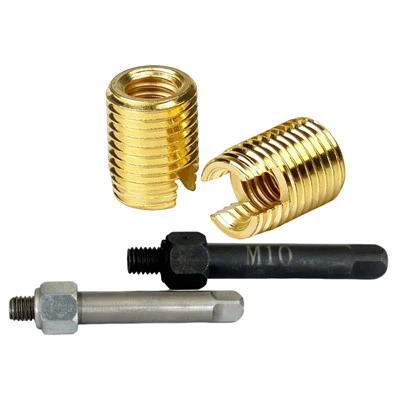
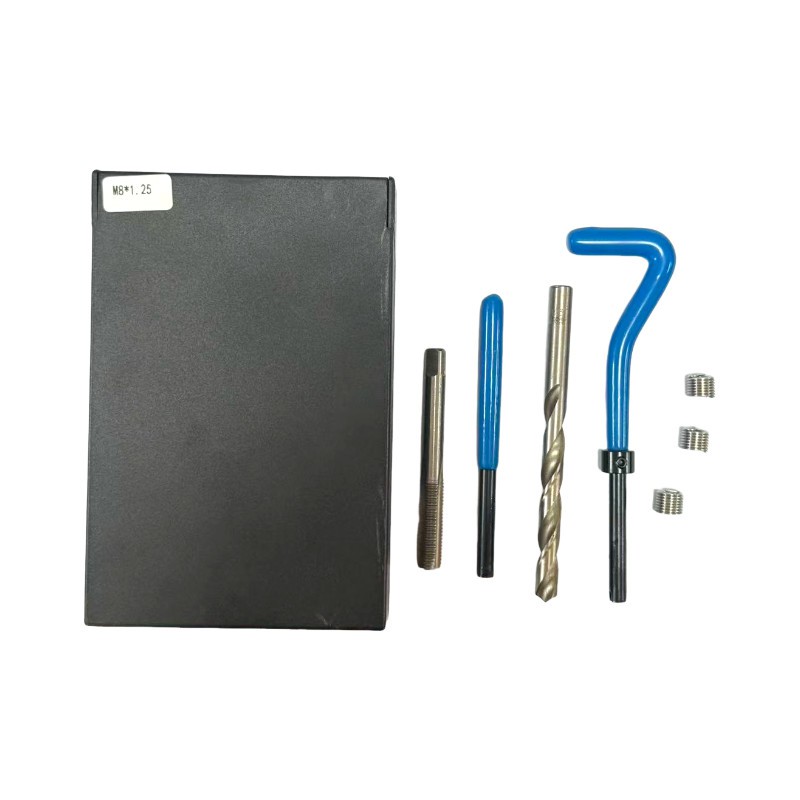


Stainless Steel Thread Insert Kit – Professional Repair Solution
Our Stainless Steel Thread Insert Kit is a comprehensive solution designed to restore and reinforce damaged or worn threads in metal components. Engineered for durability and precision, this kit ensures a secure and long-lasting repair in applications ranging from automotive engines to industrial machinery. Each kit contains a selection of inserts, installation tools, and taps tailored to standard metric and imperial threads.
Key Features & Advantages
- Premium Material: Inserts crafted from corrosion-resistant 304/316 stainless steel, ensuring high strength and longevity.
- Precision Fit: Engineered to meet ISO and ANSI standards for reliable thread engagement.
- Complete Kit: Includes installation taps, insertion tool, and wrenches, providing an all-in-one solution.
- Enhanced Durability: Stainless steel construction resists wear, vibration, and temperature fluctuations.


Material & Manufacturing Process
Each insert is manufactured using high-grade stainless steel, cold-formed for superior hardness and surface finish. Advanced CNC threading and quality inspections ensure consistent dimensions and performance. The kit components undergo corrosion testing in accordance with ASTM B117 salt spray standards, confirming resilience in harsh environments.
Installation Guide – Step-by-Step Precision Process

To ensure optimal performance and maximum thread strength, follow the standardized installation procedure below. This method is aligned with common industry practices for thread repair systems.
Use the recommended drill size corresponding to the insert dimension to remove the damaged thread completely.
- Ensure the hole is drilled perpendicular to the surface
- Maintain correct depth to match insert length
- Remove all debris and chips after drilling
Use the included STI (Screw Thread Insert) tap to cut new internal threads.
- Apply cutting oil to reduce friction and improve surface finish
- Keep the tap aligned vertically to avoid thread misalignment
- Rotate steadily (forward 1 turn, back 1/4 turn) to break chips
Load the stainless steel insert onto the installation tool and screw it into the tapped hole.
- Ensure the insert follows the thread smoothly without cross-threading
- Install until the top coil sits 0.25–0.5 pitch below the surface
- Do not over-tighten to avoid deformation
After installation, remove the driving tang using a tang break tool or punch.
- Apply a sharp downward force to snap the tang cleanly
- Ensure no fragments remain inside the hole
Verify the installation quality before use:
- Insert is flush or slightly below the surface
- Internal threads are clean and undamaged
- Fastener engages smoothly without resistance
Repair Kit Specification Parameter
|
Thread Size |
Standard |
Drill Bit Size
|
Tap Size
|
Insert Qty
|
|
M3x0.5x2D |
Metric |
3.1 |
M3x0.5 |
25 PCS |
|
M4x0.7x2D |
Metric |
4.2 |
M4x0.7 |
25 PCS |
|
M5x0.8x2D |
Metric |
5.2 |
M5x0.8 |
25 PCS |
|
M6x1.0x2D |
Metric |
6.3 |
M6x1.0 |
25 PCS |
|
M8x1.25x2D |
Metric |
8.3 |
M8x1.25 |
25 PCS |
|
M10x1.5x2D |
Metric |
10.4 |
M10x1.5 |
25 PCS |
|
M12x1.75x2D |
Metric |
12.4 |
M12x1.75 |
25 PCS |


How to Select the Right Thread Insert Kit
Selecting a suitable stainless steel thread insert kit should be based on actual repair conditions rather than size coverage alone. The following criteria provide a practical and engineering-oriented approach for accurate selection.
Repair Frequency
● Low-frequency use: Standard multi-size kit is sufficient
● High-frequency / workshop use: Choose extended kits to ensure continuous availability and reduce downtime
01
Operating Conditions
● General conditions: Standard A2 stainless steel inserts
● Corrosive / high-humidity environments: A4 stainless steel recommended
● High vibration: Prefer longer inserts (≥1.5D) for improved retention
02
Thread Damage Level
● Minor wear / partial stripping: 1D inserts are adequate
● Severe damage / oversized threads: ≥1.5D inserts required
● Repeated failure cases: Upgrade both insert length and material grade
03
Assembly Load & Cycle
● Static or low-load applications: Standard configuration
● Frequent assembly/disassembly: High durability inserts with precise tapping required
04
Tooling Configuration
● Complete kit required: Select kits including drill, STI tap, and installation tools
● Existing tooling available: Insert-only or modular kits can be considered
05
Applications / Use Cases – Specialized Industry Solutions
Design beyond conventional repair scenarios, our Stainless Steel Thread Insert Kit is widely adopted in niche and high-precision industries where reliability directly impacts safety, performance, and lifecycle cost.
Renewable Energy Equipment
Thread inserts are used in mounting systems and structural connections exposed to outdoor environments.
- Resists corrosion from humidity, UV exposure, and temperature fluctuations
- Maintains fastening integrity in long-term static load conditions
Typical use: solar panel brackets, wind turbine auxiliary components

Railway & Transportation Infrastructure
Applied in maintenance of rail systems and transport equipment requiring vibration resistance and long service cycles.
- Prevents thread loosening under continuous dynamic loads
- Suitable for periodic inspection and reassembly environments
Used in: rail fastening systems, carriage assemblies

Medical Devices & Equipment
Used in non-implant mechanical components where precision and repeatability are essential.
- Ensures consistent thread engagement in sterilizable metal housings
- Supports repeated assembly without thread degradation
Examples: diagnostic equipment frames, surgical device housings

Agricultural Machinery
Used in tractors, harvesters, and equipment exposed to dust, vibration, and heavy loads.
- Restores worn threads in frequently serviced machinery
- Reduces replacement cost of large mechanical parts
Suitable for: engine housings, structural joints, repair workshops

FAQ
Q: What is the recommended hole tolerance before installation?
A: The drilled hole should follow the specified diameter for the corresponding STI tap, typically within standard machining tolerances. Excessive deviation may affect thread quality and insert retention.
Q: How to avoid cross-threading during installation?
A: Ensure the insert is aligned with the tapped thread before installation. Start slowly by hand and maintain axial alignment throughout the process. Misalignment at the initial stage is the primary cause of cross-threading.
Q: What happens if the insert is installed too deep or too shallow?
A: ● Too deep: May reduce effective thread engagement
● Too shallow: Can interfere with bolt seating
The recommended position is 0.25–0.5 pitch below the surface for optimal performance.
Q: Can thread inserts be used in thin-wall materials?
A: Yes, but careful selection is required. Shorter inserts (1D) and precise drilling/tapping are recommended to avoid weakening the surrounding material.
Q: How to ensure proper load distribution after installation?
A: Use the correct insert length and ensure full thread engagement with the fastener. Proper installation torque and alignment are critical to achieving uniform load distribution.
Q: What are common installation mistakes to avoid?
A: ● Incorrect drill size selection
● Improper tapping (poor thread quality)
● Forcing the insert during installation
● Skipping tang removal
Avoiding these errors ensures optimal performance and longevity.
Hot Tags: stainless steel thread insert kit, China stainless steel thread insert kit manufacturers, suppliers, factory, Wire Thread Insert Repair Kit, M4 Keysert Thread Repair Kit, Stainless Steel Thread Insert Kit, Helicoil Thread Repair Kit, Helicoil type Repair Kit, Helicoil UNC Thread Insert Kit