Wire Thread Inserts: Wire thread inserts are made of 303 stainless steel or carbon steel, with zinc phosphate treatment to improve wear resistance. These kits are suitable for soft materials such as aluminum and magnesium alloys, effectively dispersing stress and enhancing vibration resistance and anti-loosening performance. For example, some products are labeled with a tensile strength ≥1034 N/mm² and a hardness of HRB43-50, suitable for high-vibration environments such as automotive chassis. Special tools are required for installation, and the steps include drilling, tapping, and screwing in. It is recommended to control the rotation speed at 800-1200 rpm to avoid material deformation.
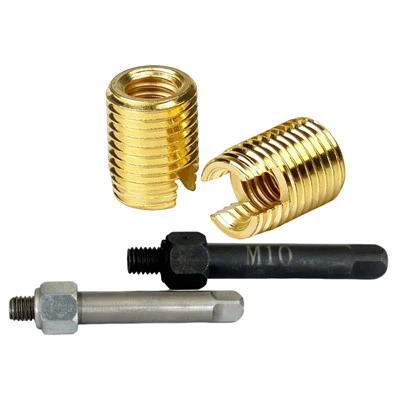
Self-Tapping Thread Inserts: Self-tapping thread repair kits allow direct insertion into the base material without pre-tapping, simplifying the operation process. These products feature a double-groove or triple-hole design with a minimum drilling depth of 8-27 mm, suitable for materials such as aluminum alloys and cast iron. The advantage lies in strong fatigue resistance, but care must be taken during installation; over-tightening may cause deformation.
Pin Thread Inserts: Pin thread repair kits use mechanical pin locking for fixation, suitable for high-frequency disassembly scenarios. The kit covers outer diameters from M2 to M12, employing a cold extrusion process to ensure precision, and comes with a dedicated tap and wrench. In the aerospace field, its anti-loosening performance meets aerospace-grade standards, but installation must be strictly performed according to the following steps: drilling → tapping → screwing in → pressing in the pin. The pin pressure is recommended to be controlled at 5-10 N·m.