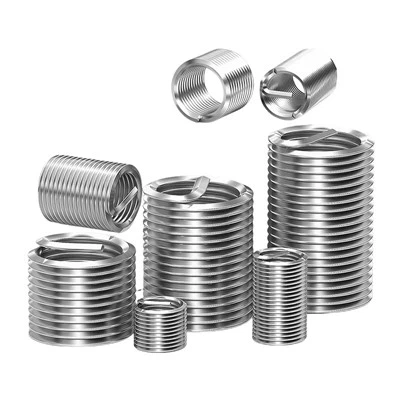


A threaded sleeve insert also called a screw thread insert (STI), is an insert made of stainless steel or phosphor bronze wire, with a diamond cross section, coiled to form inner and outer threads. The coil of wire screws into a threaded hole, where it forms a smaller-diameter internal thread for a screw or stud. These inserts provide a convenient means of repairing stripped internal threads. These inserts are commonly sold in kits with matched taps and insert tools.
In soft materials, they are used to provide stronger threads than can be obtained by direct tapping of the base materials, e.g. aluminium, zinc die castings, wood, magnesium, plastic.
Types of Inserts
Threaded sleeve inserts are available in two basic styles: Free Running Inserts. The standard Free Running insert provides a smooth, unrestricted internal thread for easy assembly.Screw-Locking Inserts. Screw-Locking inserts feature one or more coils with locking chords that apply a prevailing self-locking torque to the mating screw.Both styles are available in Tanged and Tangless designs, as well as in Inch and Metric thread series.
Note: Inch series Screw-Locking inserts are color-coded red for identification.
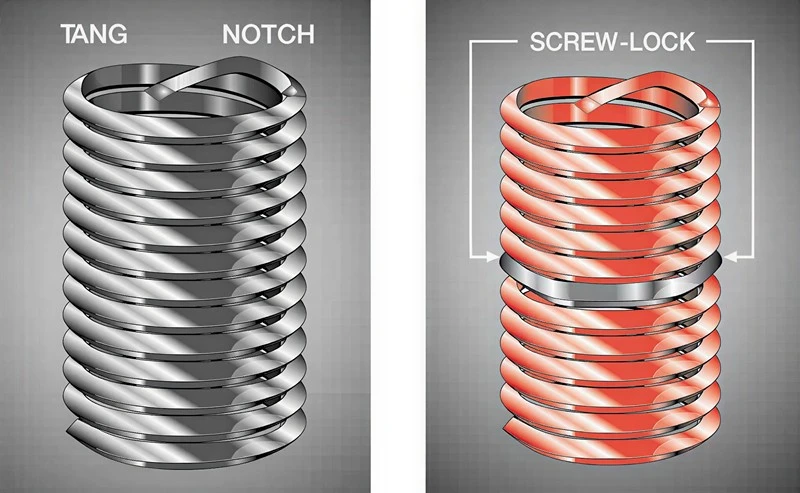

Threaded Sleeve Inserts are precision-formed from high-strength, diamond-shaped 304 stainless steel. When installed into an STI tapped hole, they create a permanent standard 60° internal thread.Installed inserts accept any standard bolt or screw meeting MIL-S-7742 and AS8879 (UNJ root radius) specifications.Custom materials are also available.Tanged Heli-Coil inserts have a slightly larger diameter than the tapped hole before installation.During installation, torque applied to the tang compresses the leading coil, allowing it to enter the hole. Once installed, each coil expands like a spring, locking the insert securely in place.
Inserts are also available in UNEF, UNS, 8UN, 12UN, 16UN, Spark Plug and Pipe Thread
Tanged Size Range:
» UNC #1 through 1-1/2
» UNF #2 through 1-1/2
» Metric Coarse M2 through M60
» Metric Fine M2 through M60
Material Selection Available

304 Stainless Steel
» Standard general purpose masterial
» Ideal for original equipment aplications,
repair and overhaul
» Stocked in most sizes
Material Spec:
Temperature range: up to 800°F
Tensile: 200,000 - 250,000 PSI
Hardness: RHc 43-50
Corrosion resistance: Moderate
Magnetic Permeability: 2-10 G/o
(depending on wire size)
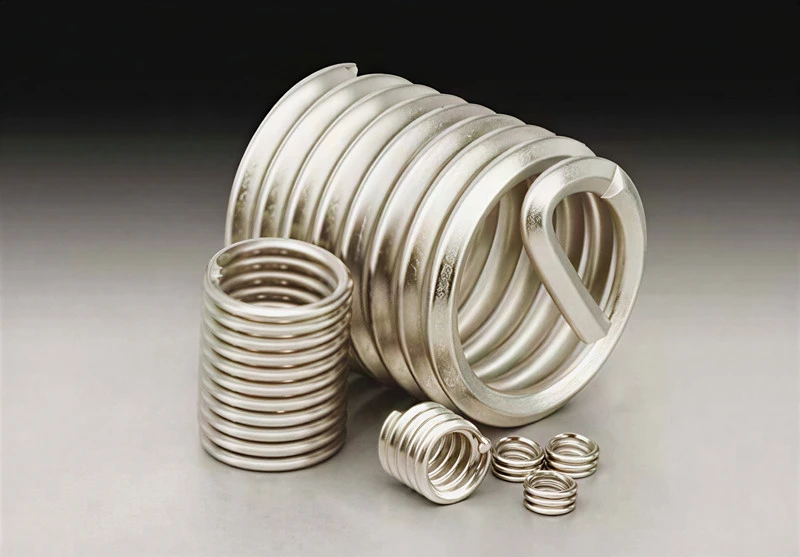
Nitronic 60
» superb gall resistance
» Compatible with stainless steel screws
» Ideal for use in vacuum environments
» Requires no additional coatingsor plating
» Particle free
» Non-magnetic
Material Spec:
Temperature range: up to 500°F
Tensile: 200,000 PSI
Hardness: RHc 43-50
Corrosion resistance: Moderate
Magnetic Permeability: <1 G/o

Inconel X-750
» Used in areas exposed to high temperatures
» Typical uses: gas turbine engines, nuclear applications, well drilling
» Non-magnetic
Material Spec:
Temperature range: up to 1000°F
Tensile: 200,000 PSI
Hardness: RHc 43-50
Corrosion resistance: High
Magnetic Permeability: <1 G/o

Phosphor Bronze
» Ideal for salt water applications
» Non-magnetic
» Excellent electrical conductivity
Material Spec:
Temperature range: up to 250°F
Tensile: 140,000 PSI
Hardness: HRB 95
Corrosion resistance: High
Magnetic Permeability: <1 G/o
Benefits of Wire Threaded Slevee Inserts
Wire threaded inserts provide multiple advantages, making them an ideal solution for strengthening threaded connections:
● Enhanced Strength: They evenly distribute loads across threads, reducing the risk of stripping or wear.
● Thread Restoration: Perfect for repairing damaged or worn threads, saving on component replacement costs.
● Corrosion Resistance: Made from stainless steel or other resistant materials, ensuring durability in harsh conditions.
● Superior Thread Retention: Locking or keyed inserts prevent loosening caused by vibration or temperature changes.
● Wide Compatibility: Suitable for use in metals, plastics, and composite materials.
● Cost and Time Efficiency: Faster and more economical to install compared to alternative thread reinforcement methods.
● Reliable Performance: Provides consistent, high-quality threaded connections over time.
● Simple Installation: Can be installed with basic tools, reducing complexity and labor effort.

Helicoil vs Other Thread Repair Solutions

In thread repair applications, Helicoil inserts are not the only available option. Other widely used repair methods include threaded rivet inserts, solid threaded inserts, and adhesive-based thread repair materials. Each of these solutions offers distinct strengths and limitations, making them suitable for specific working conditions and repair requirements. The comparison below evaluates these methods in terms of key factors such as mechanical performance, overall cost, ease and speed of installation, service life, and load-carrying capability.
|
Repair Solution |
Material Type |
Installation Difficulty |
Service Life |
Load Capacity |
Typical Application Scenarios |
|
Helicoil Insert |
Spring steel, Stainless steel, titanium alloy |
Medium (requires special tools) |
Long-lasting (high wear resistence) |
High (improve by 30%-50%) |
Aerospace automotive engines, machinery repai |
|
Threaded Rivet Nut |
Solid metal rivet nut |
High (requires riveting tools) |
Long-lasting |
Relatively high |
Heavy-load mechanical structures, heavy industry |
|
Solid Threaded Insert |
Stainless steel, copper, other soild materials |
Low (mechanical press-in or threaded insertion) |
Long-lasting |
Very high |
High-strength connections, mold manufacturing |
|
Adhesive Repair Compound |
Chemical adhesives |
Low (easy to operate) |
Short-to medium-term |
Low to medium |
Light-load or temporary repairs |
Performance Comparison
● The spring structure of the Helicoil Insert offers excellent elasticity and load-bearing capacity, especially suitable for frequent disassembly and vibration conditions, with outstanding fatigue resistance.
● The threaded rivet sleeve and solid rivet sleeve have a sturdy structure and extremely high load-bearing capacity, making them suitable for heavy-duty and high-strength mechanical connections. However, their installation is complex and the cost is high.
● The adhesive repair agent is suitable for light-load environments or temporary repairs, but is not suitable for high-strength or high-frequency disassembly scenarios.
Cost and Installation Time
● The installation of Helicoil requires specialized tools and certain technical skills, but the overall working time is relatively short and the cost performance is quite good.
● The installation process of threaded rivets and solid rivets is cumbersome, the required equipment is expensive, and the working time is long with high maintenance costs.
● The adhesive repair agent is simple and quick to operate, but its lifespan is limited and the long-term maintenance cost may be higher.
Service Life
● Helicoil and metal sleeves have a long service life and are suitable for long-term high-intensity use.
● Adhesive repair agents have a shorter lifespan and are mostly used for emergency or light-load applications.
Parameters of Large-Size Threaded Sleeve Inserts
|
Nominal Diameter |
Pitch |
Nominal xD |
Length |
Coil (W) |
Free-State OD(Dz) |
Drill Bit Diameter(do) |
Drilling Depth(L3) |
Actual Effective Length (L2) |
|
M56 |
4 |
0.5d |
28 |
5.4 |
64.0~65.0 |
57 |
44 |
24 |
|
0.75d |
42 |
8.6 |
58 |
38 |
||||
|
1d |
56 |
11.8 |
72 |
52 |
||||
|
1.5d |
84 |
18 |
100 |
80 |
||||
|
M60 |
3 |
0.5d |
30 |
7.9 |
69.0~70.0 |
61 |
42 |
27 |
|
0.75d |
45 |
12.4 |
57 |
42 |
||||
|
1d |
60 |
16.9 |
72 |
57 |
||||
|
1.5d |
90 |
25.9 |
102 |
87 |
||||
|
M60 |
4 |
0.5d |
30 |
5.8 |
69.0~70.0 |
61 |
46 |
26 |
|
0.75d |
45 |
9.2 |
61 |
41 |
||||
|
1d |
60 |
12.6 |
76 |
56 |
||||
|
1.5d |
90 |
19.5 |
106 |
86 |
FAQ
Q: Are wire threaded inserts stronger than tapped threads?
A: Yes. After installation, the insert distributes load evenly along the entire length of the thread, resulting in higher pull-out strength and improved torque resistance compared to directly tapped threads in the base material.
Q: Will the insert loosen or come out during service?
A: No, when properly installed.
The insert expands radially after installation, creating a spring-like locking effect that permanently anchors it in the tapped hole. Under normal operating conditions, the insert will not rotate or back out.
Q: Do wire threaded inserts affect assembly torque or clamping force?
A: No negative effect.
In fact, inserts often improve torque consistency and clamping reliability by providing a more uniform and wear-resistant internal thread compared to the base material.
Q: What materials are wire threaded inserts made from?
A: The most common material is 304 or 316 stainless steel, offering excellent strength and corrosion resistance.
Other materials such as Inconel, phosphor bronze, or customized alloys are available for high-temperature, aerospace, or special environments.
Q: Is special tooling required for installation?
A: Yes, but it is simple and standardized.
Installation typically requires:
● STI tap
● Insertion tool
● Tang break-off tool (for tanged inserts)
Once installed, no special tools are needed for normal assembly.
Q: Why choose wire threaded inserts instead of oversizing the thread?
A: Oversizing reduces wall thickness and weakens the component.
Wire threaded inserts restore the original thread size while improving strength, making them a safer and more reliable solution.
Hot Tags: threaded sleeve insert, China threaded sleeve insert manufacturers, suppliers, factory, Thread Repair Inserts, Threaded Inserts M10, Helical Wire Insert, Free Running Coil Insert, Threaded Screw Inserts, wire thread inserts